
The starter deck, card by card
Every run begins with the same 13 cards regardless of character, and three of the Combat cards are duplicates. Knowing what they do explains most of the early advice about food and about deck size.
| Deck | Card | What it does |
|---|---|---|
| Explore | Shovel | Digs for weapons and other cards, and is the main way you find new Explore cards. |
| Explore | Key | Unlocks and consumes itself. Worth saving for a trade rather than spending on the first lock you meet. |
| Explore | Rest | Heals 9 health, gains 3 healing per upgrade, and starts the next combat with Well Rested. |
| Explore | Bash | Unlocks a door, deals 4 damage to you, and is Handy and Persistent. |
| Explore | Map | Looks at the current floor layout. Handy, Persistent and Replenish. |
| Explore | Rat Jerky | Heals 3 health and draws a card. A food card, so it heals inside combat too. |
| Combat | Flash | Costs 0 energy, applies 3 Vulnerable, and holds a battery of 10. |
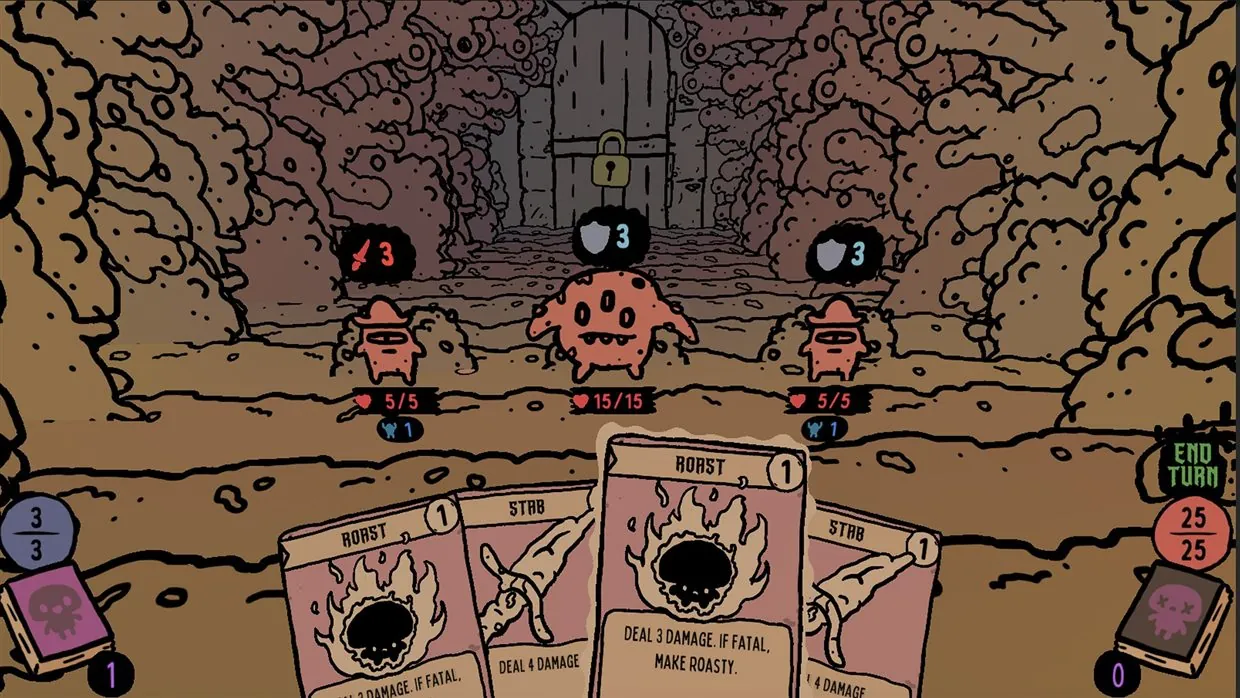
| Combat | Roast ×3 | Deals 3 damage and creates a Toasty when the hit is fatal, which is where the food supply comes from. |
| Combat | Stab ×3 | Deals 4 damage for 1 energy, with no other effect. |
Three of the thirteen are food, and one of those is the attack that makes more food. That is why early upgrades on Roast pay off twice: the card gets better at killing, and it produces more healing as a side effect.
What the type tags mean
Cards carry a type tag that tells you which systems they talk to. The tags matter because several camp buildings and enemies only interact with one type, so a card that looks weak in isolation can be the one a building wants.
- ATTACK
- Damages enemies directly. Most of these live in the Combat deck.
- FOOD
- Heals. Food in the Combat deck is what makes in-fight healing possible in the caves.
- SKILL
- Utility that is not damage: unlocking, drawing, buffing, applying Vulnerable.
- CURSE
- A negative card, usually added by an enemy or an event, that takes up a slot until you get rid of it.
- DATA
- Facility-side resource cards. The route has its own card pool and its own currency of the same name.
- MACHINE
- Cards tied to machine-type effects, also introduced by The Facility route.
- PASSIVE
- Effects that stay in play rather than resolving once.
- SPECIAL
- One-off cards tied to a specific source rather than a general category.
- MOOD
- Effects produced by the Concerned Parent camp building, the Shrine.
The tag is not a ranking. A CURSE card is meant to be a problem, and a FOOD card with no damage is often the most valuable card in the deck by the middle of a run.
Why the card total depends on who is counting
The developers have never published a card count for this build, so every number in circulation comes from a database someone built by reading the game files or the game itself. That makes each figure a measurement of a specific build rather than an official constant.
The community database that is most transparent about this lists 907 cards in total, then splits the number itself: roughly 900 pages for cards present in the current build, split into about 437 Explore and 470 Combat, plus 7 pages kept for cards the build no longer contains. The same database keeps same-name upgrades and interaction variants on one page rather than counting them separately.
- Quote a card total with its build attached, or not at all.
- Do not treat any total as an official figure, because none has been published.
- Expect the number to move. Early Access has already shipped patches since launch.
The three habits that matter most
Card advice in this game follows from the deck-splitting more than from any individual card. Because your Explore and Combat decks are separate, and because duplicates of weak cards dilute the deck you draw from, the useful habits are about composition rather than about chasing specific cards.
- Remove Stab when you can. Three copies of a plain 4-damage attack are the cards most likely to be dead in your hand later on.
- Save Key for a trade rather than using it on the first door, and spend Shovel on spare energy so unwanted cards do not enter the deck.
- Keep at least six units of food in the Combat deck before you shop for the first time, because shop currency and healing draw on the same pool in the caves.
Card values change between patches, and the demo uses a different build from the Early Access game, so a screenshot from one will not always match the other. The official Steam news hub is where the changes are announced.
The older itch.io prototype predates both the demo and the Early Access build and uses a different card set entirely. Do not read its cards as current.