
Why a ranked list would mislead you
Everything in this game is modifiable. The official store copy says you can modify rare cards into game-breaking super-weapons and that cards can be grown and modified infinitely. A card that is mediocre when you find it can become the strongest thing in your deck by the last floor, and one that starts strong can stay where it is while everything else grows past it.
The second reason is that decks are small. With a thin deck you see the same few cards every turn, so the question of which card is best stops being about individual power and starts being about what the rest of the deck does around it. A card that wins alone and a card that multiplies another card are both excellent, and they are not comparable.
No card totals or drop rates have been published, so any list claiming to rank all cards by strength is working from an incomplete pool and unknown availability. Treat the criteria below as the durable part.
The main source of strength: camp upgrades
Camp buildings are where cards get better, and the scale of it is the thing most new players underestimate. A community count of the camp buildings lists 96 upgrades spread across 33 buildings, and a building usually offers a few of its upgrades at a time rather than all of them.
Among those upgrades are a handful that change a card more than any other single choice will. They are worth recognising on sight, because they turn a card you were going to replace into the centrepiece of the deck.
- Multiply damage by 1.5
- Multiplicative, so it scales with everything else you do to that card. The single most impactful upgrade named in player reports.
- Reduce energy cost by 1
- Lets you play the card more often in a turn, which matters more in this game than in most deckbuilders because the boss fights restrict how many cards you can play.
- If fatal, increase damage by 2
- Applies repeatedly across a run as you keep killing with the card, so it compounds on its own.
- If fatal, increase damage on all
- The same idea applied across the deck rather than to one card.
- If you eat, gain rage
- Turns every food card into a fuel source for the rest of the fight.
- Add 5 damage
- Flat, but it arrives early and it is the reliable choice when nothing better is on offer.
The building that matters most is the Practice Dummy, because it shapes your attacks directly. One player summarises its four options as adding 5 damage, adding a fatal bonus, an extra attack, or multiplying damage by 1.5. The Kitchen is the second one to prioritise if your damage runs through eating enemies, since its upgrades chain off kills.
A community tip worth adopting: get at least six food cards into your combat deck before your first shop. Food is the healing system, so a deck that cannot feed itself spends its camp visits on recovery instead of on upgrades.
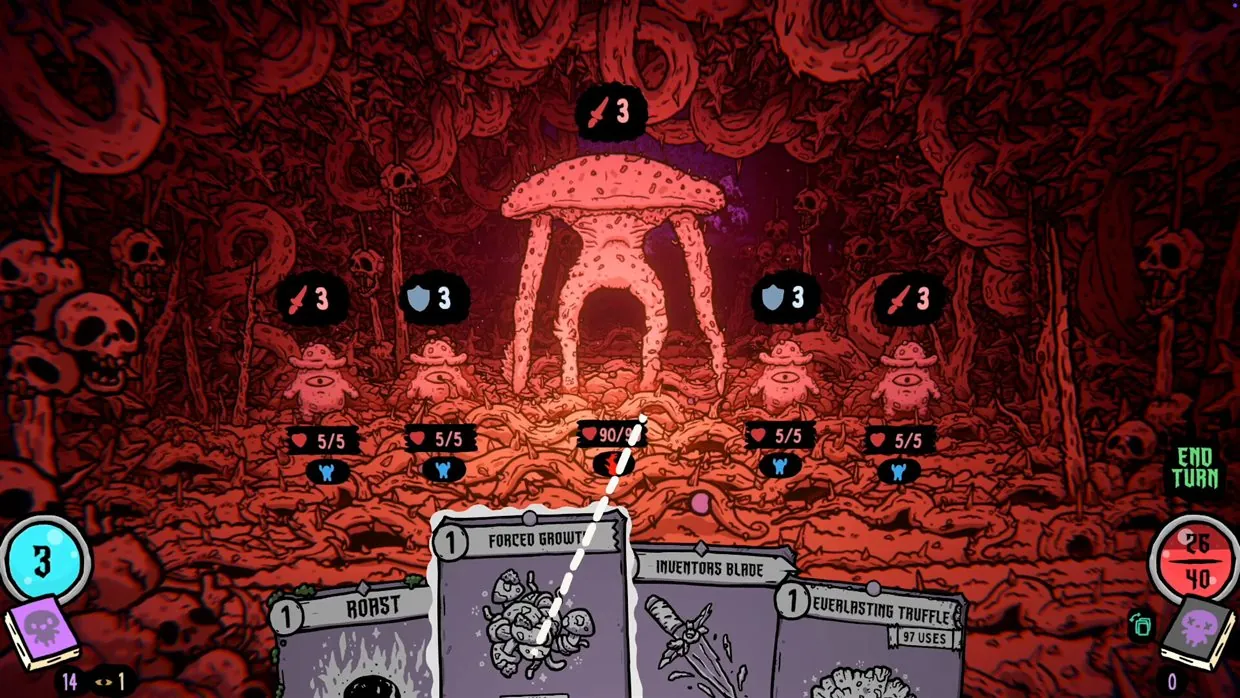
Useful cards by situation
The comparisons below are grouped by the problem you are solving rather than by power. Each entry names what the card does for the deck around it, which is the part that carries across runs.
| Situation | What people reach for | Why it works there |
|---|---|---|
| You need raw damage on one card | A machine that grows, such as the Clunker | Machine cards take multiplier upgrades well, and one player reports reaching roughly +300 damage by the boss after two doubling upgrades. |
| You want to play more cards per turn | Anything with a reduced energy cost, plus energy gain | Boss fights restrict how many cards you can play, so cost reduction is effectively extra turns. |
| You need to see your good cards | Card draw, and the Employee Handbook | Card draw gets called the most valuable property in the game, and the Handbook is described as reusable rather than consumed. |
| You want consistency without thinking | Turrets and data cards | Named as the reliable pick across runs regardless of character, which makes them a safe default while you learn. |
| You are setting up a big hit | Vulnerability and status application | Stacking vulnerable before a large attack is the standard way to convert a good card into a lethal one. |
| You need to survive a long fight | Food cards and healing that triggers on kills | Food heals during combat, and effects that heal when you kill turn your damage into sustain. |
| You want a card you always have | Anything with the Handy keyword | Handy cards are always drawn first, so they reliably open your turn. |
The through-line is that these are roles rather than names. A deck wants damage that scales, a way to play enough cards, a way to draw the right ones, and a way to survive long enough for the first three to matter.
Deck size, which beats card choice
If you take one thing from this page, take this. Multiple experienced players independently describe keeping the combat deck small as the highest-value habit, to the point where one describes instant wins from an early strong card combined with a small deck.
The reason shows up in the boss fights. When a fight limits how many cards you can play each turn, every card in your deck is a chance to draw something you cannot afford to use. Cutting those cards is a larger improvement than adding a good one.
- Play the first floor or two with whatever you find, and note which cards you never want to see.
- Use the frog interactions to forget the worst of them rather than carrying dead weight.
- Pick a single scaling damage card and invest your camp upgrades into it instead of spreading them.
- Reach at least six food cards before your first shop so the deck can heal without camp.
- Cut again before the boss. If a card would not help in that fight, remove it first.
A player who won a run with the Janitor lists keeping the combat deck slim as the core of it, tracking roughly four data cards by the first stop and about seven by the second. That is a concrete target if you want a number to aim at, from one player rather than a general rule.
How to read strength claims elsewhere
Strong-card advice for this game has a quality problem, and it is worth knowing what to filter out. The clearest signal is a damage number in a headline. Videos advertising a card by an enormous damage figure are describing a specific run with specific upgrades, and that number is not reproducible from the card alone.
The second signal is whether the advice names a character and a deck size. Because strength depends on both, guidance that omits them is describing one player's run rather than a decision you can reuse.
None of this means card advice is worthless, only that it needs the conditions attached. The version matters too, since balance changes arrive with each patch.
Difficulty reports for this game are split wide enough that two players can disagree completely about the same fight, and the split usually tracks whether they found a scaling combination. That is the reason this page teaches the criteria rather than publishing a ranking. Patch notes that adjust cards appear on the official Steam news hub.