
The Map card, and what it shows you
Map is one of the six cards in your starting Explore deck, so you do not need to find it or unlock it. Its effect is a look at the current floor layout, and it costs nothing to play.
- Energy cost
- 0. Playing Map never competes with a card that does something else.
- Type
- Skill. It changes what you know rather than what is on the floor.
- Handy
- It comes back to hand rather than being spent, so the information stays available.
- Persistent
- Its effect continues rather than resolving once and disappearing.
- Replenish
- Playing it does not leave you a card down for the rest of the turn.
Treat it as a reference card you consult when a floor is confusing rather than a card you build around. The three keywords together mean there is no cost to using it early and often, which is why it sits in the starter deck permanently.
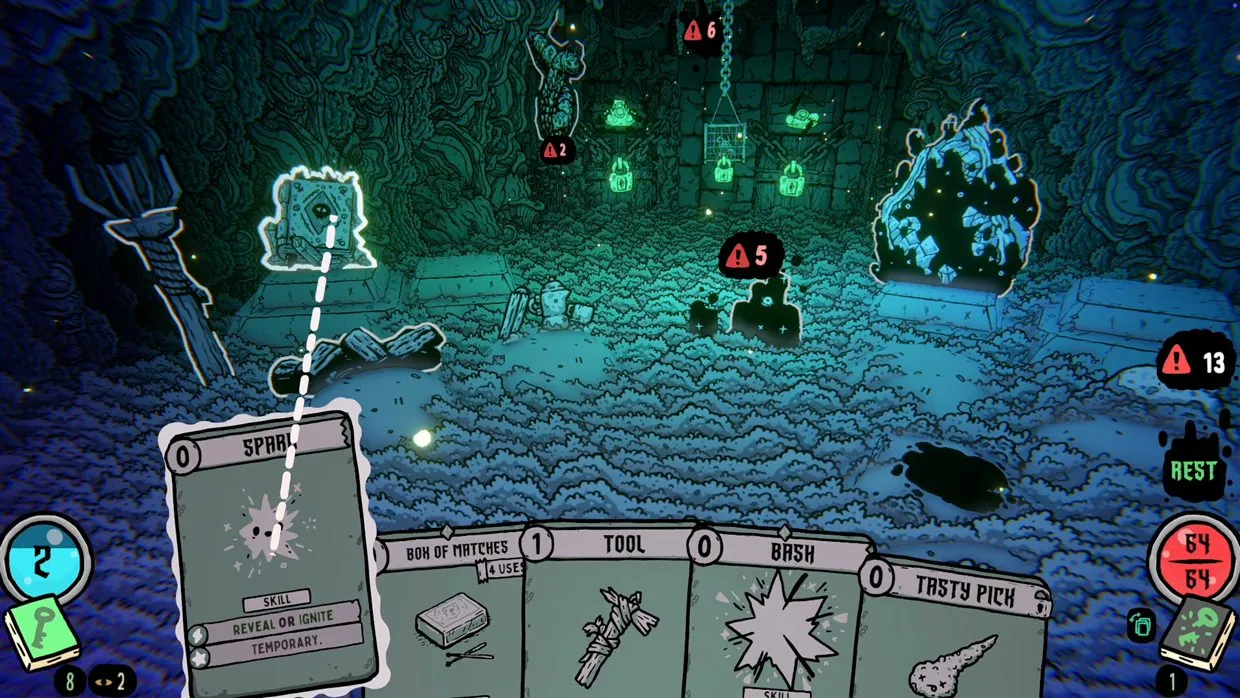
You read the floor by walking it
This is the part that trips up players arriving from other roguelike deckbuilders. There is no route diagram to click through: you move through a first-person dungeon and your own direction picks the next encounter. Turning left and turning right are different decisions.
That changes what the Map card is for. It is not a fast-travel menu or a place to plan a whole run; it shows you the layout of the floor you are standing on, which is information you can use to decide where to walk next.
Your Explore deck is what interacts with the space. Keys open doors, shovels uncover buried objects, and camp structures make exploration safer. That is why an Explore card that looks useless in combat can be the one that opens the next part of a floor.
Two things push against staying put. Remaining in an area for too long lets the surrounding Gloom become more dangerous, and resting or drawing another hand consumes Warmth, the property that protects you from danger.
The two pathways at launch
The caves are the route the game introduces you with, and reviews describe them as the more forgiving of the two. Their loop centres on FOOD and CAMP, and they let you heal during combat. Most of the early advice about cooking enemies and eating them belongs to this route.
The second route is The Facility, which the developers announced in a dedicated video on June 23, 2026. It is not a harder version of the same map. Reviews and player write-ups describe it as asking you never to heal in combat and to heal at camp instead, and it introduces its own mechanics: GUNK, DECAY, MACHINES and FAMILIARS.
| The caves (Gloom) | The Facility | |
|---|---|---|
| Healing in combat | Available, and the route teaches it | Not the intended route; camp is the heal |
| Route focus | FOOD and CAMP | GUNK, DECAY, MACHINES, FAMILIARS |
| Own card pool | Shared Explore and Combat decks | Adds its own resource and card types |
| Announced | Launch, September 10, 2026 | June 23, 2026 developer video |
The announcement itself is worth watching if you want the developers' own framing of the second pathway. It is titled "This Place Was Never What You Thought - Introducing The Facility - A Shroom and Gloom Update" and describes the route as a whole new pathway in the game. Patch notes for either route are posted on the official Steam news hub.
Why you see the route count as two and as three
Two is the count the launch coverage uses, and it matches what the developers announced: the caves and The Facility. That is the number this page states as the launch figure.
You will also see three in player threads, usually from someone describing how they unlocked a character or what they completed a run on. One reading is that a third path exists and the coverage missed it; another is that a hidden or derived route is being counted separately; a third is that an announced but unreleased route was included. The disagreement is not resolved in the sources this site works from, so it is reported here rather than settled.
The practical advice is the same either way. When a player says they cleared three paths, ask which build they were on and what they counted, and treat your own run as a two-route game unless you find the extra one yourself.
Which route details change by version
Anything describing the route structure is tied to a build, and Early Access builds move. The facts below are the ones this page treats as settled for the September 2026 build, and the ones it deliberately does not.
- Settled: Map is a 0 energy starter Explore card that reveals the current floor layout.
- Settled: movement is first-person and directional, so encounters are chosen by walking.
- Settled: The Facility exists, was announced June 23, 2026, and has its own mechanics.
- Not settled: whether a third route is playable. Sources disagree and this page does not pick a side.
- Watch out: the older itch.io prototype predates Early Access and is a different game.
The prototype linked from the developer's itch.io page describes a dense network of caves and tunnels as the dream version of the game. That page is the pre-Early Access prototype, so do not read its route description as a description of the current build. The itch.io prototype is a separate download from the Steam build.
One criticism that appears in professional coverage and in player threads is content reuse: the same enemies, bosses and room layouts come back often enough that a floor can feel familiar on a second run. That is a fair expectation to set before you buy, and it is not a statement about how the routes are structured.