
What soup actually does
Soup cards are FOOD cards. Everything that applies to food applies to them: they heal when you play them, and you can play them during a fight, which is what makes the caves route forgiving.
What separates soup from the rest of the food in your deck is the effect attached to the heal. Where a Roast produces a Toasty that restores a small amount of health, a soup can hand you a damage card, an energy, or a permanent increase to one of your stats.
That is why the developers describe them as game-changing. The official store description puts it as throwing roasted enemies into a pot and cooking up soups that change the state of a fight.
The Soup Pot, and how you get soup at all
The Soup Pot is a camp building, and camp buildings are Explore cards you play to place a structure. Its card text reads: place a Soup Pot, use Edibles to make soups, consume. Being consumed on use means you place it once per camp.
The building is one of a set that modifies your run at the camp rather than in a fight. It sits alongside the Kitchen, which seasons your weapons, the Practice Dummy, which sharpens your attacks, and the Camp Fire, which adds Warmth. None of them are combat cards, and all of them change what your deck does later.
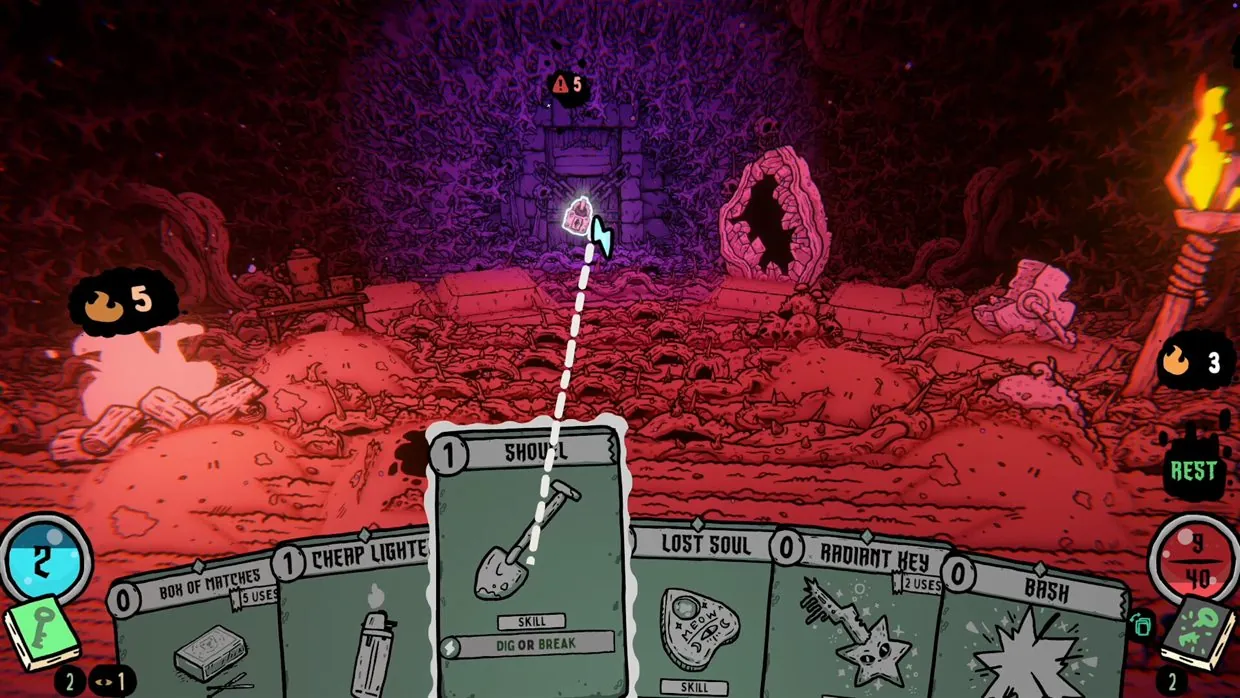
The exact ingredient chain is not documented in one place. The store description says roasted enemies go into the pot, the camp building says the pot takes Edibles, and community write-ups describe combining multiple enemies into one soup. Those may all be true at once with Edibles covering roasted enemies, but no source this page works from spells out the chain, so it is not stated as one here.
The soups you can find, and what each one is for
The named soups below come from a community database built against the Early Access build. The naming pattern is consistent enough to be useful for planning, and the individual values should be treated as that database's reading of the cards rather than as figures the developers published.
| Soup | Effect | What it is for |
|---|---|---|
| Awesome Soup | Heal 6, draw a damage card, gain 1 energy | The all-round pick; the draw and the energy both matter in a long fight. |
| Endless Soup | Heal 3, draw a food card | Converts into more food, so it extends the chain rather than ending it. |
| Fiery Soup | Deal 7 damage | The damage option. Notably it is still a FOOD card, so it heals as well. |
| Growing Soup | Increase damage by 3 | A permanent upgrade for the run, not a one-off. |
| Hearty Soup | Increase maximum health by 3 | Raises the ceiling for the rest of the run. |
| Holy Soup | Increase healing by 3 | Makes every heal after it larger. |
| Spicy Soup | Deal 3 damage | The small version of the damage soup. |
| Soup Crumbs | Heal 1 | Leftovers: a small heal with no other effect. |
Read the table by looking at what each one does on top of healing, because the heal is the smallest part of most of them. Awesome Soup is the clearest example: 6 health is unremarkable, but a free damage card and an energy in the same play is a turn you did not otherwise have.
The permanent ones are the ones worth planning around. Growing Soup, Hearty Soup and Holy Soup all add 3 to a stat that persists, so they compound with everything else you do afterwards, while Fiery and Spicy Soup only pay out once.
What changes whether soup is worth it
Soup is as strong as the camp you build it in, and that is the variable to watch rather than the soup itself. A Soup Pot placed in a camp where you are also placing a Camp Fire and a Kitchen is several buildings competing for the same camp, and the effects they hand out are not the same size.
- Which route you are on. The caves run on FOOD and CAMP, so food effects stack with the route; The Facility heals at camp instead, which changes what a food card is worth to you.
- How many camp stops you get. A building is consumed when you place it, so soup is a per-camp decision rather than a permanent unlock.
- Whether the effect is permanent. Growing, Hearty and Holy Soup improve the rest of the run; Fiery and Spicy Soup are single plays.
- How much food is already in the deck. Soup competes for slots with the Toasty line of cards, and a deck with too much food has less room for damage.
One caution, and it applies to any single soup: the official description is marketing copy written to sell the range of effects, not a claim that every soup is strong. Soup Crumbs heals 1. The useful question is which soup you are holding, not whether soup is good.
Which parts of this have changed and which have not
Soup itself is not an Early Access addition. It appeared in the publishing announcement and in the demo material months before launch, described the same way, as roasted enemies going into a pot for soups.
Skill cards are what moved. Patch notes during the demo period recorded changes such as camp structures no longer being able to draw evolve cards or cards with limited uses, which is exactly the kind of rule that changes what a Soup Pot is worth in a given build.
For that reason, treat the values in the table as a snapshot of one build. The official Steam news hub carries the patch notes, and the in-game card text is the version that decides the run you are actually playing.